Soundsulate's 1 lb mass loaded vinyl carries a proven STC rating of 27 — a number that comes from actual testing, not marketing copy, and applies consistently across the Next Generation line.
The LAG fiberglass composite and all acoustical drop ceiling tiles carry a Class A (Class 1) fire rating per ASTM E84 and UL723 — the certification commercial contractors need to pull permits without a second conversation.
Every banding buckle and stainless wire coil is T-304 grade — 18% chromium, 8% nickel — the alloy outdoor industrial specs actually call for, not a lighter substitute dressed up in the same name.
Soundsulate MLV won't off-gas, decompose, or create indoor air quality concerns — it's safe behind drywall, under flooring, inside a car door, and anywhere else you'd install it without second-guessing the material.
Soundsulate's acoustic barrier products — mass loaded vinyl, the LAG fiberglass composite, and drop ceiling tiles — share a customer base with the stainless steel wire and banding hardware lines: contractors, facilities professionals, and experienced builders who need materials that perform to spec and hold up in the field. Whether you're wrapping a noisy pipe or securing insulation banding on an industrial duct run, the same commitment to verifiable specs runs through every line.
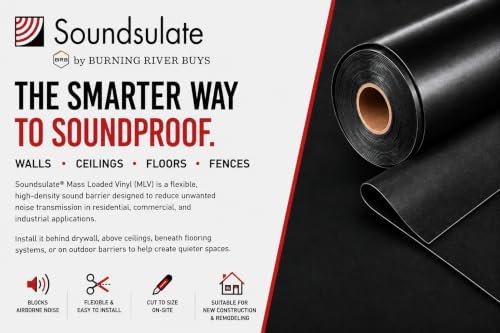
Dense, flexible vinyl at 1/2 lb or 1 lb per square foot — blocks airborne noise like voices, traffic, and machinery hum in walls, floors, ceilings, automotive, and HVAC applications with a proven STC rating of 27.
Fiberglass drop-in tiles in black or white, 1" and 2" thick, rated NRC up to 1.0 — designed to cut reverb and echo inside a room, not to block sound between floors. Class A fire rated per ASTM E84.
The LAG composite pairs 1/8" foil-faced MLV with 1" or 2" quilted fiberglass — absorbs first, then blocks, then dissipates reflections. STC up to 29, Class A per ASTM E84. Built for pipe, duct, and tank wrap.
T-304 stainless wire in 16 and 18 gauge, coil sizes from 3.5 lb to 25 lb — corrosion-resistant and made in the USA for rebar tying, fencing, HVAC insulation hanging, garden trellises, and craft applications.
Clip-style wing seals in T-304 stainless or hard-temper aluminum, sized for 1/2" and 3/4" banding — the hardware that locks an insulation wrap or sign strap permanently after crimping with a standard tensioning tool.
Browse the complete brand catalog with up-to-date pricing on Amazon.
These 12 products account for the bulk of Soundsulate's review volume — the 1 lb MLV flagship alone has 371 ratings, the 16-gauge wire coil sits at 4.6 stars across 141 reviews — which usually means buyers arrived with a specific project, found a spec that matched, and came back to leave a note about how the install went.
Soundsulate's mass loaded vinyl line is built around one core principle: mass blocks airborne sound. The 1 lb Next Generation MLV — re-engineered for tear resistance and a professional finish — carries a proven STC rating of 27 at 1/8" thick and 1 lb per square foot. The 1/2 lb variant (STC 20, 1/16" thick) covers higher-square-footage projects where weight is a constraint. Both lines are non-toxic, won't off-gas, and ship in roll sizes from a 60 sf starter to pallet-quantity commercial rolls covering over 2,000 sf. For commercial permit applications, the FSK-reinforced variant adds a foil-scrim-kraft facing that improves tear resistance and fire performance.
The right MLV weight depends entirely on what kind of noise you're dealing with and where you're installing it. For most residential wall and ceiling applications blocking voices, TV audio, and street traffic, 1 lb per square foot — STC 27 — is the appropriate choice. The 1/2 lb variant (STC 20) covers lighter-duty needs where mass requirements are lower. Going heavier only earns its cost in specific situations.
Before picking a weight, name your problem. MLV blocks airborne sound — voices, music, machinery hum, HVAC noise, traffic. It does not stop impact noise: footsteps from upstairs, a dropped dumbbell, bass vibration traveling through structure. If your problem is primarily impact, no amount of MLV will solve it. You need decoupling — either the Soundsulate LAG composite with its quilted fiberglass layer, or a separate underlayment product. Installing 2 lb MLV on a ceiling beneath an active walking surface and expecting to stop footfall is the most common expensive mistake in this category.
If your problem is genuinely airborne — a loud neighbor's TV bleeding through a shared wall, road noise entering a home office, engine sounds in a car door — MLV is the right tool. Then weight selection matters.
The half-pound line makes sense for applications where adding significant mass isn't practical or necessary. Automotive door panels and trunk lids, HVAC duct wraps, light pipe insulation work, and machinery enclosures where you need some airborne attenuation without the weight penalty of the 1 lb product. At 1/16" thick, it adds almost no bulk. The STC 20 rating is a real number — it's a meaningful barrier against mid-to-high frequency airborne noise, but don't expect it to touch low-frequency content the way 1 lb does.
The 4' × 25' roll (100 sf, 50 lbs) works for automotive and small duct projects. The 4' × 50' roll (200 sf, 100 lbs) covers a standard bedroom wall in one run. For commercial-scale work, the 4' × 50' × 15-roll pallet (3,000 sf) and the 4' × 505' continuous roll (2,020 sf) exist for contractors who need consistent material across a full job.
This is the right product for the majority of residential and light commercial applications. Walls, floors, ceilings, home theaters, recording studio liners, automotive firewalls — 1 lb is where the mass-law physics start delivering noticeable results for most human-frequency noise sources (voices peak around 500–2,000 Hz, where MLV performs best).
The 4' × 15' roll (60 sf, 60 lbs) is the starting point for single-room projects — enough to treat one wall or a car's floor pan. The 4' × 25' roll (100 sf, 100 lbs) covers a medium bedroom wall with ceiling drop. For bigger projects, the pallet configurations — 7 rolls × 100 sf (700 sf total), 5 rolls × 135 sf (675 sf total), and the large continuous rolls at 1,020 sf and 1,102 sf — serve contractors who need consistency and don't want to manage individual roll inventory on a job site.
The Foil-Scrim-Kraft facing version of the 1 lb MLV (4' × 25', 100 sf) adds tear resistance and a vapor barrier function to the same STC 27 acoustic performance. It's not a higher-performing acoustic product — it's a more durable one. The FSK facing matters in applications where the MLV surface will be exposed to moisture, mechanical abrasion, or handling stress: HVAC mechanical rooms, pipe chases, commercial installations where the barrier won't be immediately covered by drywall. The Class A fire rating on the FSK variant also makes it the right call for any commercial space where code compliance is required.
Here's what the forums and YouTube videos almost never say clearly: the single most impactful thing you can do for MLV performance isn't upgrading from 1 lb to 2 lb. It's sealing every seam, gap, and penetration. Research in architectural acoustics consistently shows that a gap covering just 1% of a barrier's surface area can cut the barrier's effective STC performance in half. One unsealed electrical outlet. One unsealed seam where two rolls meet. One gap where the MLV meets the floor plate without sealant. Any of these undoes the mass you paid for.
Seal every overlap with acoustic tape or acoustic sealant. Caulk every penetration. Carry the material to the edges — don't stop 2 inches short of the ceiling. Before you consider whether you need 2 lb instead of 1 lb, ask whether your 1 lb installation is actually sealed. For most buyers, it isn't, and that's where the performance went.
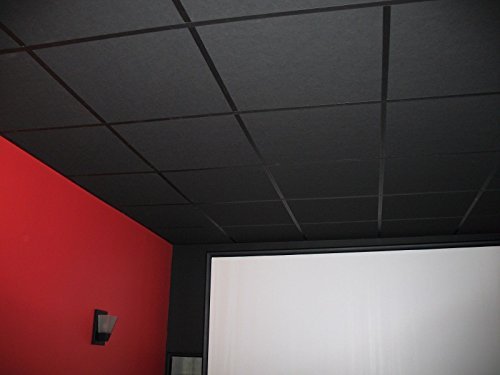
Soundsulate's drop ceiling tiles are acoustic absorbers, not sound blockers — and that distinction matters before you buy. Made from soft fiberglass with a rigid non-woven facing, they drop into any standard grid and reduce in-room reverb and echo, improving speech clarity in offices, home theaters, restaurants, and studios. The 1" tiles reach NRC up to 0.7; the 2" tiles push that to NRC 1.0, meaning they absorb essentially all sound energy that contacts them. Both thicknesses carry a Class A fire rating per ASTM E84 and UL723. Available in black matte and white/light gray, in both 24" × 24" and 24" × 48" sizes — each box covers 80 sf at 1" thickness and 40 sf at 2".
Soundsulate acoustic drop ceiling tiles absorb sound inside a room — they reduce echo, reverberation, and the slap-back that makes speech hard to understand in hard-surfaced spaces. They do not block sound transmission between floors. That distinction isn't a fine-print disclaimer — it's the entire reason people install the wrong product and then post negative reviews. Getting this straight before you buy saves a weekend of work.
STC (Sound Transmission Class) measures how well a material blocks sound from passing through a barrier — through a wall, floor, or ceiling. A higher STC means less sound bleeds from one space to the next. This is what people mean when they say "soundproofing."
NRC (Noise Reduction Coefficient) measures how much sound a material absorbs rather than reflects, on a scale from 0 to 1.0. An NRC of 0.70 means the tile absorbs 70% of the sound energy that strikes its surface — the remaining 30% bounces back. This is acoustic treatment, not soundproofing.
Soundsulate's drop ceiling tiles are NRC products. The 1" tiles carry NRC up to 0.70. The 2" tiles reach NRC up to 1.0 — meaning they absorb effectively all the sound that hits them across most of the audible frequency range. Neither thickness carries an STC rating, because these tiles aren't designed to block sound from traveling between floors. A competitor's drop ceiling tile that claims both STC and NRC performance is worth scrutinizing closely — the physics of a lightweight drop-in tile don't support meaningful STC performance on their own.
If your problem is that a room sounds terrible — conversations echo, music sounds muddy, you can't have a meeting without everyone talking over each other — acoustic ceiling tiles are exactly the right fix. The mechanism is straightforward: hard parallel surfaces (floor and ceiling) create standing waves and flutter echo. Breaking up the ceiling reflections with absorbent material kills those reflections before they build into the reverberant field that makes rooms acoustically uncomfortable.
Drop ceiling grids are common in basements, office spaces, restaurants, classrooms, and home theaters precisely because they're easy to install and retrofit. Soundsulate's tiles drop into any standard ceiling grid — actual tile size is 23.75" × 47.75" for the 2×4 format and 23.75" × 23.75" for the 2×2 format, fitting standard T-bar grid openings. The fiberglass core and rigid non-woven facing are lightweight enough to install overhead without fatigue. Both black and white/light gray color options are available; note that the white tiles will have a slight light gray appearance once installed.
The 1" tiles (NRC up to 0.70) handle most residential and commercial acoustic treatment needs. For a home theater, home office, podcast room, or conference space, 1" tiles absorb enough mid-to-high frequency energy to clean up speech intelligibility and reduce distracting reverb. The 10-tile package covers 80 sf in the 2×4 format; the 20-tile package covers 80 sf in the 2×2 format.
The 2" tiles (NRC up to 1.0) are for rooms where low-frequency absorption matters — recording studios, home theaters treating bass buildup, commercial spaces with significant mechanical noise in the mid-bass range. The extra inch of fiberglass depth extends the absorption down into lower frequencies where 1" tiles start losing effectiveness. They also cover less area per package: 5 tiles for 40 sf (2×4 format) and 10 tiles for 40 sf (2×2 format). If low-end boom or muddiness is your specific complaint, the 2" tiles earn their thickness.
If noise is genuinely traveling between floors — footsteps, bass from a subwoofer below, voices carrying up through the structure — drop ceiling tiles alone won't fix it. What you need is mass above the ceiling plane (MLV draped over the tile grid), decoupling between the subfloor and the ceiling structure, and batt insulation in the cavity. Acoustic ceiling tiles handle the last piece of the puzzle — the in-room reverberant field — but only after the structural isolation work is done.
The honest sequence: if someone upstairs can hear you clearly, tiles will not solve that. If you're in a room that sounds like a gymnasium, tiles will make a substantial difference. Both problems are real, but they require different solutions, and one product doesn't cover both.
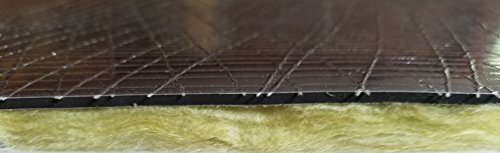
The Soundsulate LAG product combines 1/8" foil-faced mass loaded vinyl with a quilted fiberglass decoupler — either 1" or 2" thick — in a single composite that handles both absorption and blocking in one wrap. Sound waves hit the fiberglass first and lose energy before reaching the MLV barrier; any reflections that bounce back get absorbed into the fiberglass rather than radiating outward. The result is STC up to 29, compared to STC 27 for bare 1 lb MLV, and the outer foil-scrim-kraft layer adds a vapor barrier alongside a Class A fire rating per ASTM E84. It's specifically designed for pipe, duct, and tank applications where bare MLV would gap at seams on curved surfaces — the fiberglass layer conforms while the FSK outer facing seals moisture out.
The Soundsulate LAG composite — 1/8" foil-faced mass loaded vinyl laminated to a quilted fiberglass absorber, finished with a Foil Scrim Kraft (FSK) outer layer — reaches STC up to 29 on pipes and ducts. That's a modest improvement over bare 1 lb MLV at STC 27, but the number undersells what the product actually does differently. The fiberglass layer solves a problem that MLV alone can't address.
MLV blocks airborne sound by adding mass to a surface. That works well on flat surfaces — walls, floors, ceilings — where the material lays flat, seams can be properly overlapped, and flanking paths are manageable. On round pipes and irregular duct surfaces, bare MLV creates two problems: it doesn't conform well to curved surfaces (gaps appear at seams almost immediately), and it does nothing for the structure-borne vibration that travels through the pipe wall itself.
A water supply pipe transmits both types of energy simultaneously. Water hammer, pressure fluctuations, and pump vibrations travel as structural vibration through the pipe wall. Turbulent flow and mechanical noise from pumps and valves also radiate as airborne sound from the pipe surface. MLV addresses the second. The fiberglass decoupler in the LAG product addresses the first — it breaks the rigid contact between the pipe surface and the MLV barrier, preventing structural vibration from bypassing the mass layer entirely.
Understanding the order of materials in the LAG wrap explains why the layering matters. From the noise source outward:
The sequence matters. MLV on the outside, fiberglass on the inside, would still block some airborne sound — but it wouldn't decouple the structure-borne vibration path, and the fiberglass would pick up moisture from the pipe surface rather than serving as a vapor barrier from the outside in.
The 1" fiberglass variant (B07DNLV3HT, 135 sf per roll, 4.5' × 30') handles most pipe and duct wrapping applications — HVAC supply and return lines, domestic hot and cold water lines, mechanical room pipe chases. At 1" of fiberglass plus 1/8" MLV plus FSK facing, the assembly is flexible enough to wrap around most standard pipe diameters without buckling at the seams.
The 2" fiberglass variant (B07CR51QV6, 2 rolls of 135 sf each, 270 sf total) is for situations with significant low-frequency mechanical noise — large-diameter return air plenums, chilled water lines on commercial HVAC systems, or pump discharge lines where the dominant noise is low-frequency vibration below 500 Hz. The extra inch of fiberglass depth provides meaningful additional absorption in the lower mid-range that 1" of fiberglass starts to miss. It's also thicker and less flexible, so confirm that your pipe diameter and bend radii can accommodate the assembly before ordering.
The smaller roll (B07DHBHST7, 50 lbs, 1" fiberglass) suits partial installations or individual pipe runs. The sample piece (B07DH9Z5MS, 24" × 24" × 1", 10 lbs) exists specifically for buyers who want to verify material properties, thickness, and flexibility before committing to a full roll.
Cutting: use a sharp utility knife. Score the FSK outer facing first, then cut through the fiberglass and MLV in one pass on a hard surface. The assembly cuts cleanly — the MLV layer is 1/8" thick and scores without tearing if the blade is sharp.
Wrapping a round pipe: spiral-wrap the material so each pass overlaps the previous by at least 2". On a straight pipe run, butt-joint wrapping (running the material lengthwise, overlapping seams along the top of the pipe) is faster and maintains consistent fiberglass thickness. The FSK facing tears and separates at sharp bend radii — pre-cut relief cuts in the fiberglass layer at elbows and tees before wrapping, then patch the FSK facing over the cut with FSK tape.
Sealing: every FSK seam needs to be sealed with FSK tape — the foil-scrim-kraft tape that matches the outer facing. Unsealed seams break the vapor barrier and create flanking paths for airborne noise. The Class A fire rating depends on the complete assembly including sealed seams. A taped, sealed LAG wrap installation is what earns the ASTM E84 classification — not the raw material alone.
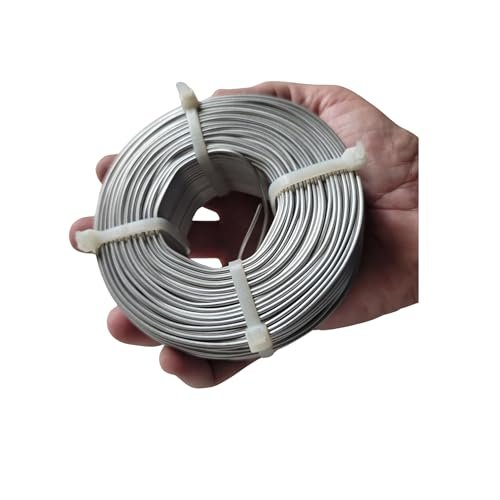
Soundsulate's stainless steel wire line covers two gauges — 16 ga (0.0625" diameter) and 18 ga (0.047" diameter) — in T-304 stainless throughout. The 16-gauge coils run from 3.5 lb (360 ft) up to a 25 lb commercial coil at 2,341 feet; the 18-gauge line covers 3.5 lb (588 ft) and 5 lb options. All wire is non-magnetic, corrosion-resistant, and rated for service temperatures up to 2300°F. The 18-gauge wire meets ASTM A580 and ASTM A555 specifications. The flagship 16-gauge 3.5 lb coil is the highest-rated product in the Soundsulate catalog at 4.6 stars across 141 reviews — which typically means it goes on a lot of different kinds of projects and doesn't cause problems on any of them.
The Soundsulate wire line covers two gauges in multiple coil sizes — 16 gauge (0.0625" diameter) and 18 gauge (0.047–0.0475" diameter), all T-304 stainless steel, all made in the USA. The gauge choice comes down to one question: does the application require wire you can bend repeatedly by hand with precision, or wire that holds significant tension under load? Those are different mechanical requirements, and they point to different gauges.
Sixteen gauge is the heavier wire. At 0.0625" diameter, it has higher tensile strength and resists deformation under load — which is why it's specified for rebar tying, concrete reinforcement, structural fencing, and any application where the wire needs to hold something in place against significant force. Construction contractors tying rebar on a slab use 16 gauge because it stays put after twisting; lighter wire can spring loose under concrete vibration.
The 3.5 lb coil (B008XKU0VS, 360 feet, 4.6/5 stars from 141 reviews) is the most practical size for most construction and general-purpose jobs — manageable enough to carry around a job site, enough footage to finish a substantial run of rebar or fencing without a mid-job resupply. The 5 lb coil (B088F58145, 468 feet) suits larger projects where you want fewer coil changes. For high-volume contractor work, the 25 lb coil (B01LR3LCJ6, approximately 2,341 feet) is the right buy — at that scale, per-foot cost drops and you're not stopping to open a new coil every hour.
Eighteen gauge is noticeably more flexible. You can work it with your hands more easily, form it into tight radii without using tools, and make precise bends without the wire springing back aggressively. That's why the community on r/maille and r/chainmailartisans uses it — 18 gauge hits the range where jump rings for chainmail and wire-wrapped jewelry components are practical to form by hand. It's also used for HVAC insulation hanging (securing fiberglass batts to duct surfaces), garden trellises, vine training, and light bundling applications.
The 3.5 lb coil (B00XKHS3QS, 588 feet, 4.5/5 stars from 72 reviews) is the standard size and the better starting point if you haven't used this product before — 588 feet gives you enough for a serious project without committing to bulk. The 5 lb coil (B0055BM4R6, approximately 581–840 feet depending on source; 0.0475" diameter; made in USA; service temperature up to 2,300°F) suits ongoing craft or professional work. Note that the 18 gauge product's service temperature spec — up to 2,300°F — makes it appropriate for applications near heat sources where ordinary galvanized wire would degrade.
All Soundsulate wire is T-304 stainless — 18% chromium, 8% nickel alloy. This grade resists rust and corrosion in most indoor, outdoor, and mild chemical environments. It's non-magnetic (relevant for applications near sensitive electronics or magnetic fields) and maintains its corrosion resistance in rain, humidity, and moderate chemical exposure. The 18 gauge wire meets ASTM A580 and ASTM A555 specifications, which matter for contractors who need to document material compliance on commercial jobs.
One honest note on grade limitations: T-304 is not rated for marine environments with continuous saltwater immersion or chloride exposure. If you're doing marine rigging in an environment with constant salt spray contact, T-316 stainless is the correct specification — it adds molybdenum to the alloy for chloride resistance. T-304 handles coastal outdoor conditions adequately; it's prolonged submersion in salt brine or chlorinated environments where the grade starts to show its limits.
Soundsulate's banding buckles and wing seals are clip-style fasteners that lock stainless steel banding permanently after crimping — no welding, no adhesive, no improvising. The T-304 stainless steel variants (18% chromium, 8% nickel) handle outdoor industrial exposure, pipe insulation strapping, sign installation, and duct securing. An aluminum variant in hard-temper ASTM B-209 aluminum covers lighter-duty interior work where corrosion isn't a factor and weight matters. T-304 buckles come in 3/4" and 1/2" widths, with quantity options from 100 pieces to 1,000 — sized for single-job use through full contractor inventory. Compatible with standard banding tensioning and crimping tools; hand installation is not an option with wing seals.
Wing seal buckles don't work without a compatible banding tensioner and crimping tool — they can't be hand-tightened to a secure finish. Getting this right before you order saves a job-site trip back to the supplier. Soundsulate's wing seals come in two widths (1/2" and 3/4") and two materials (T-304 stainless steel and aluminum), and each must match the banding you're using and the task you're doing.
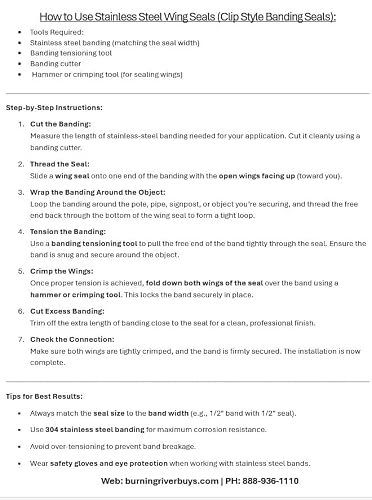
A wing seal is a clip-style buckle. The installation sequence: run your stainless steel banding around the object (pipe, pole, duct, bundle), pull both ends through the wing seal so they overlap inside the clip, tension the band with a banding tensioner tool to the required tightness, then crimp the wings of the seal with a banding crimper — the wings fold over the overlapping band ends and lock them permanently. No welding, no adhesives, no threads to strip.
The critical point: the banding tool must match the banding width. A 3/4" tensioner won't properly tension 1/2" banding, and a 1/2" tool won't seat correctly on 3/4" material. The wing seal width must also match the banding width exactly — a 3/4" wing seal used with 1/2" banding will slip rather than hold. The system only works when all three components (banding, buckle, tool) are matched by width.
The T-304 stainless wing seals — 18% chromium, 8% nickel alloy — are the standard choice for industrial, outdoor, and corrosive-environment applications. At T-304 grade, they resist rust and oxidation in most outdoor conditions, HVAC mechanical rooms, and chemical exposure environments where galvanized hardware would corrode within months.
Available configurations:
The 3/4" width is the more common specification for pipe and duct insulation banding, sign mounting, and cable management. The 1/2" width suits lighter applications — securing insulation jackets to smaller-diameter pipe, pole signage, or bundling work where narrower banding is specified.
The aluminum wing seals (B07XDMM4TJ, 100 pieces, 1/2" width) are manufactured from hard-temper aluminum conforming to ASTM B-209 specification, 0.032" thick. They're the right choice for applications where corrosion resistance is needed but the load demands are lower than what an industrial pipe installation would put on a buckle — interior sign mounting, lightweight insulation securing, and any application where weight savings matter and the assembly won't see tensile loads that require stainless strength.
Don't use aluminum wing seals where the banding will be under sustained high tension outdoors or in environments with aggressive chemicals. The T-304 stainless version handles those conditions significantly better. But for a sign shop doing interior signage work, or a contractor securing lightweight pipe insulation in a conditioned space, the aluminum seals are the practical choice — and they're made in the USA, which matters for certain commercial specifications.
| Application | Banding Width | Buckle to Order |
|---|---|---|
| HVAC pipe and duct insulation banding | 3/4" | T-304 SS 3/4" (100, 500, or 1,000 pc depending on job scale) |
| Industrial pipe wrap, outdoor cable management | 3/4" | T-304 SS 3/4" wing seal — matched to banding width |
| Light insulation securing, smaller-diameter pipe | 1/2" | T-304 SS 1/2" (100 pc) or aluminum 1/2" for lighter duty |
| Interior sign mounting, lightweight bundling | 1/2" | Aluminum 1/2" (ASTM B-209, lighter duty, made in USA) |
One more thing: if you're ordering buckles for the first time and aren't sure which banding tensioner tool to use with them, the wing seal installation requires at minimum a manual banding tensioner and a separate sealer/crimper tool — these are standard industrial strapping tools available from most industrial supply houses. The buckles alone don't come with tooling, and attempting to crimp wing seals with standard pliers produces an unreliable connection.
Soundsulate's 1 lb MLV carries a verified STC 27 rating. That number is the most useful starting point for any comparison, because STC is what separates products with real acoustic data behind them from those selling on vague claims. Not every MLV on Amazon publishes a tested STC value. Soundsulate does.
AudioSeal (from Acoustical Solutions) is the closest direct category competitor with similarly documented performance data. AudioSeal's standard 1 lb MLV is marketed with STC ratings in the same general range and similar non-toxic material claims. Where Soundsulate differentiates is in the composite LAG product — the MLV-plus-fiberglass-decoupler combination that AudioSeal doesn't offer in a single roll format — and in the range of commercial pallet configurations for high-volume contractor ordering. AudioSeal is primarily positioned for architectural and commercial acoustic consulting projects; Soundsulate covers both that market and the direct-to-contractor/DIY Amazon channel where immediate availability and single-roll pricing matter.
Honestly, both products are credible. If you're a commercial acoustic consultant spec'ing a wall assembly for a permit submission, either will work. If you're a contractor buying off Amazon for a residential job and need the product in three days, Soundsulate's in-stock status and direct Amazon storefront is an advantage.
This is where the comparison gets more meaningful for most buyers. There's a significant volume of unbranded or thinly branded MLV on Amazon that claims "STC 27" without citing a testing standard, lab report, or methodology. Some of these products measure accurately; others don't. The problem isn't necessarily that generic MLV is bad — it's that you can't verify it. Soundsulate publishes its STC 27 rating on the product page and the claim is consistent across all 1 lb variants (the 4' × 15', 4' × 25', 4' × 255', 4.5' × 245' rolls all carry the same specification).
The other differentiation is the "Next Generation" reformulation — the current Soundsulate 1 lb MLV was re-engineered for tear resistance and improved handling. Contractors who've used older vinyl-loaded barrier materials know that original-formulation MLV could be brittle at edges and prone to tearing at fastener points. The current Soundsulate product handles and installs more like a professional building material, which matters on a job where you're cutting and fastening 700+ square feet of the stuff.
SecondSkin's Luxury Liner Pro is aimed squarely at the automotive and home theater segment, typically sold in smaller quantities at a higher per-square-foot cost than Soundsulate's residential or commercial rolls. The Luxury Liner Pro claims both decoupling and mass-loading in a single product, while Soundsulate's approach separates the mass layer (MLV) from the decoupler (LAG composite) so buyers can choose the right combination for their specific install rather than paying for both properties everywhere. For a full vehicle interior build, the Luxury Liner Pro's pre-combined format has installation speed advantages. For a wall or ceiling application where you're laying flat rolls, buying Soundsulate MLV and treating decoupling separately with resilient channels or the LAG product gives you more control over the assembly.
No Soundsulate MLV product claims complete silence. No single-layer barrier does. An STC 27 barrier reduces sound transmission meaningfully — a loud conversation that was clearly audible through an untreated wall becomes muffled and harder to follow — but it doesn't eliminate it. Claiming otherwise is how soundproofing products lose credibility with buyers who then discover the gap between marketing and physics. The product page language is accurate: "blocks airborne sounds" with a "proven STC rating of 27." That's an honest claim, and it's what the product delivers when installed correctly with sealed seams and proper edge treatment.
Three Soundsulate product lines carry formal fire or material certifications that matter for commercial permit applications: the LAG composite (Class A/Class 1 per ASTM E84), the acoustic drop ceiling tiles (Class A per ASTM E84 and UL 723), and the 18 gauge stainless wire (ASTM A580 and ASTM A555). These aren't marketing designations — they're the standards building code officials and mechanical inspectors reference when reviewing submittals.
ASTM E84 is the Standard Test Method for Surface Burning Characteristics of Building Materials, commonly called the "Steiner Tunnel Test." It measures two things simultaneously: flame spread index (FSI) and smoke developed index (SDI). Class A (also called Class 1) means flame spread index of 0–25 and smoke developed index of 0–450 — the most restrictive classification, required in most commercial occupancies, plenum spaces, and HVAC applications under model building codes including the International Building Code (IBC).
Both the Soundsulate LAG pipe and duct wrap and the acoustic drop ceiling tiles carry Class A / Class 1 ratings per ASTM E84. What this means practically: these products can be used in commercial mechanical rooms, above drop ceilings in plenum-rated spaces, and in commercial HVAC applications without requiring additional fire protection treatment — provided the installation matches the tested assembly. A contractor pulling a mechanical permit on a commercial HVAC retrofit who specifies Soundsulate LAG can point to the ASTM E84 Class A documentation to satisfy the building department's fire performance requirement.
The Soundsulate drop ceiling tiles carry a dual certification: both ASTM E84 and UL 723. UL 723 is Underwriters Laboratories' standard for surface burning characteristics — it tests the same properties (flame spread and smoke development) using equivalent methodology to ASTM E84. Having both certifications means the tiles meet two independent testing protocols, which some commercial specifiers require when both model code compliance (IBC references ASTM E84) and UL listing are part of the project specification. For a school, healthcare facility, or commercial office build-out where the architect's spec sheet lists both standards, Soundsulate ceiling tiles satisfy both lines on that submittal without needing a substitution request.
The Soundsulate 18 gauge stainless wire (B00XKHS3QS) meets ASTM A580 (Standard Specification for Stainless Steel Wire) and ASTM A555 (Standard Specification for General Requirements for Wire Rods and Coarse Round Wire, Carbon Steel). These standards define chemical composition tolerances, mechanical property requirements, and dimensional tolerances for wire products. For contractors doing commercial HVAC insulation work where the hanging wire must meet specific material specs for inspection, or for fabricators who need to document material compliance on a submittal, these certifications confirm that the wire meets published industry standards — not just manufacturer claims.
All Soundsulate stainless banding buckles and wing seals are T-304 stainless steel: 18% chromium, 8% nickel alloy. T-304 is the most widely used austenitic stainless steel grade in industrial applications — it's what's specified in outdoor sign installation, HVAC banding applications, and most non-marine industrial strapping work. The alloy designation isn't just a marketing claim; it defines the corrosion resistance threshold the material will meet across its service life. A contractor installing exterior signage in a northern climate who specifies stainless banding hardware is implicitly specifying T-304 unless marine chloride exposure is a factor.
One clarification worth making explicit: T-304 is not T-316. Marine environments with sustained saltwater or chloride exposure warrant T-316, which adds molybdenum for chloride resistance. For every other industrial and commercial application — outdoor mechanical work, HVAC, pipe insulation, signage, general construction — T-304 is the standard specification, and it's what Soundsulate delivers.
We linked this walkthrough because it addresses the exact problem we hear about most: MLV that goes up correctly but delivers disappointing results because the installation method was off from the start. You'll see the right way to hang and seal mass loaded vinyl so the mass actually does its job — blocking airborne sound instead of leaving flanking paths that undo everything. Getting this process right matters far more than upgrading to a heavier vinyl, and this video shows you why.
"I used the 1 lb MLV 100sf Roll in a basement home theater build — ran it floor-to-ceiling behind the drywall layer, taped every seam with acoustic tape. Voices from the TV no longer carry into the next room. Fair warning: you really do need to seal every gap. I missed a corner the first pass and could still hear frequencies leaking until I went back and addressed it."— Daniel M., Home Theater Builder, on Mass Loaded Vinyl Soundproofing Barrier
"Bought the 1 lb MLV 1102sf Commercial roll for a restaurant renovation — one continuous pallet shipment, consistent thickness across the whole job, which matters when you're billing acoustic treatment to a client and can't have variance between runs. STC 27 as rated. Freight delivery requires coordination, so plan ahead."— Karen S., Small Commercial Contractor, on Mass Loaded Vinyl Soundproofing Barrier
"The Black Tile 2x4 1-Inch tiles dropped the slap-back in my recording booth noticeably — conversations feel cleaner, mic tracks are less roomy. I want to be clear: they don't stop sound from moving through the ceiling, just clean up what's inside the room. Once I understood that distinction, the NRC 0.7 rating made perfect sense for what I was trying to fix."— Terrence A., Podcaster and Home Studio Builder, on Acoustic Drop Ceiling Tiles
"Used the LAG Wrap 1-Inch Fiberglass on a noisy HVAC duct run in a commercial office buildout. The FSK outer layer gave us the vapor barrier we needed in a mechanical room with some humidity exposure, and the Class A fire rating meant no pushback from the inspector. Two reviews on the listing made me hesitant, but the product performed to spec."— Brian F., HVAC and Facilities Contractor, on MLV with Fiberglass Decoupler
"The 16 Gauge Wire 3.5lb Coil has been my go-to for garden trellis work for two seasons. No rust, no staining on the wood posts, and the coil unwinds without tangling — which sounds minor until you've dealt with a knotted mess halfway through a project. 304 SS is the right call for anything that sees rain year-round."— Rachel O., DIY Homeowner and Gardener, on Stainless Steel Wire
"Ordered the T-304 Wing Seal 3/4-Inch 100pc for pipe insulation banding on an outdoor mechanical install. The 18% chromium grade holds up without any surface oxidation after months of outdoor exposure. You do need a proper banding tensioner — don't try to hand-crimp these. That's not a product flaw, just a tool requirement worth knowing before you order."— Marcus T., Industrial Maintenance Professional, on Stainless Steel Banding Buckles and Wing Seals
Soundsulate MLV blocks airborne sound transmission — voices, traffic, mechanical hum — with a proven STC rating of 27 for the 1 lb per square foot product. It doesn't eliminate sound entirely. Blocking is always a matter of degree, and the rated STC assumes complete, gap-free coverage. Any unsealed seam reduces real-world performance.
No. MLV is a mass-based barrier for airborne sound — voices, music, mechanical noise. Impact noise like footsteps transmits through structure, not air, and mass alone doesn't interrupt it. For footfall noise, you need decoupling: resilient underlayment, floating floor construction, or a product like the LAG composite that combines mass and a fiberglass absorber.
Significantly. Acoustic research consistently cites the 1% rule: a gap covering just 1% of a barrier's surface area can cut effective STC performance by as much as half. Sealing every seam with acoustic tape or sealant, and treating penetrations and outlet cutouts, matters far more than upgrading from 1 lb to 2 lb MLV in most installs.
The 1/2 lb MLV is 1/16" thick and carries an STC rating of 20. The 1 lb Next Generation is 1/8" thick with an STC rating of 27. More mass blocks more airborne sound — the 7-point STC gap is real and audible. The 1/2 lb line suits lighter applications: automotive interiors, HVAC duct wrapping, and situations where the extra mass of the 1 lb product creates structural or space concerns.
Yes. The 1 lb MLV cuts with a utility knife and fastens with screws, nails, or construction adhesive directly to drywall or studs. For retrofit applications, installing over the existing wall surface and covering with a second drywall layer adds more acoustic mass to the assembly. The FSK Reinforced MLV variant holds up better in ceiling applications where tear resistance under its own weight matters.
No — and this distinction matters. Soundsulate acoustic drop ceiling tiles absorb sound inside the room by reducing echo and reverberation. Their NRC rating (up to 0.7 for 1" tiles, up to 1.0 for 2" tiles) measures absorption, not transmission blocking. If sound is traveling between floors, the tiles address how that sound behaves after it enters the room — not whether it gets through.
The 2" thick fiberglass tiles reach NRC up to 1.0 — meaning they absorb essentially all mid-to-high frequency sound energy that strikes them, compared to NRC 0.7 for the 1" tiles. The difference is most audible in spaces with significant low-frequency content: home theater bass, live music rehearsal, or machinery rooms. For standard office speech intelligibility, the 1" tiles at NRC 0.7 are typically sufficient.
The LAG product — available in 1" and 2" fiberglass versions — combines 1/8" foil-faced MLV with a quilted fiberglass decoupler and an FSK outer vapor barrier. Sound waves hit the fiberglass first (absorbing energy), then the MLV (blocking what remains), then dissipate into the fiberglass on reflection. The result is STC up to 29 versus STC 27 for bare 1 lb MLV, plus Class A fire rating per ASTM E84 for commercial applications.
Yes. The Soundsulate LAG pipe and duct wrap carries a Class 1 or A fire rating per ASTM E84 — the standard most commercial building codes reference for flame spread and smoke development. This makes it permittable in applications where bare MLV or non-rated fiberglass blankets would not meet code. Contractors should cite ASTM E84 Class A when pulling permits for commercial mechanical room or duct wrap installs.
The 16 gauge wire is 0.0625" in diameter — thicker, stronger, suited for rebar tying, fencing, structural fastening, and heavy garden trellises. The 18 gauge wire runs approximately 0.047" diameter: more flexible, easier to shape by hand, and better for chainmail, jewelry, HVAC insulation hanging, and fine craft work. Both are T-304 stainless steel (304 SS), made in the USA, and resist rust in outdoor and high-humidity environments.
Wing seal installation requires a compatible banding tensioner and crimping tool — the clips don't hold reliably without proper crimping. The T-304 SS buckles are sized to match specific banding widths: the 3/4" wing seals pair with 3/4" stainless banding, and the 1/2" wing seals with 1/2" banding. Ordering the wrong width is the most common installation error. The aluminum variant (ASTM B-209, 0.032" thick) is designed for lighter-duty sign and insulation work with 1/2" banding.
Yes, across multiple lines. The stainless steel wire (T-304, 18% chromium / 8% nickel) and banding buckles are rated for outdoor industrial use and resist corrosion from rain, humidity, and mild chemical exposure. For marine or extreme chloride environments, 316 grade stainless is generally specified — T-304 performs well in most outdoor applications but has limits in saltwater immersion. The MLV and LAG products are non-decomposing and act as moisture barriers, making them suitable for HVAC and pipe wrap in damp mechanical spaces.
Soundsulate's product line runs from mass loaded vinyl soundproofing barrier to stainless steel banding buckles and wing seals — a range that looks broader than it is once you understand who actually buys it. The MLV line came first, built around a straightforward premise: non-toxic, non-decomposing vinyl loaded to 1/2 lb or 1 lb per square foot that blocks airborne sound without the lead content that plagued earlier barrier materials. The Next Generation reformulation tightened the tear resistance and improved the finish for professional installs, while the FSK Reinforced variant added a foil-scrim-kraft facing for applications requiring a vapor barrier alongside the acoustic layer.
The mlv with fiberglass decoupler line — the LAG composite — came from a real gap the MLV-only product couldn't close. Bare MLV blocks sound; it doesn't absorb it, and it doesn't break the structural vibration path between a noisy pipe and the room around it. Laminating 1/8" foil-faced MLV to a 1" or 2" quilted fiberglass decoupler with an FSK outer layer produced a product that works in sequence: the fiberglass absorbs first, the MLV blocks what remains, and the fiberglass handles reflected energy on the way back. STC up to 29, Class A per ASTM E84 — a rating that matters to the contractors who need to pull permits. The acoustic drop ceiling tiles complete the absorption side of the equation: fiberglass tile in 1" and 2" thicknesses, NRC up to 1.0, dropping into standard grid systems for offices, home theaters, and studios where in-room echo is the problem to solve.
The stainless steel wire and stainless steel banding buckles and wing seals sit in a different category — industrial hardware — but the customer overlap is real. The same facilities managers and contractors who specify LAG wrap for a mechanical room also need T-304 banding buckles to secure it, and 16 or 18 gauge stainless tie wire to handle a hundred other fastening tasks on the same job. All of it — T-304 at 18% chromium and 8% nickel for the hardware, 304 SS for the wire meeting ASTM A580 and A555, non-toxic vinyl for the acoustic barriers — is made in the USA. That's the through-line: materials that perform to spec, stated honestly, without a long list of use cases the product can't actually handle.
Real answers to acoustic questions—no hype, just the install hours and spec sheets behind why products work or don't.
Soundsulate makes industrial-grade acoustic barriers, fiberglass-composite wraps, drop ceiling tiles, stainless steel wire, and banding hardware — all sold through the Soundsulate Store on Amazon. The full line spans residential DIY to commercial and industrial applications, with products manufactured in the USA across multiple categories.
Support for all Soundsulate product lines is handled through Amazon's messaging system. Navigate to your order in your Amazon account and use the "Contact Seller" option to reach the Soundsulate team. Response times follow Amazon's standard seller communication guidelines. All five product lines — MLV, LAG wrap, ceiling tiles, wire, and banding hardware — are supported through the same channel.
Smaller rolls and hardware ship standard. Pallet-quantity MLV and LAG products arrive via freight carrier and require a signature on delivery — plan for a loading dock or ground-level freight access. Returns follow Amazon's standard return policy. For freight items, contact the seller through Amazon messaging before initiating a return to coordinate logistics.